Autumn

Sixteen years ago today this angel left, her spirit flying off to shine in other worlds. She has been gone many more years than she was here. The time I had with her feels so short now. Yet despite this brevity, she was such a quintessential part of my time in this world that I can’t reflect on my life without considering her time in it. I no longer grieve her loss every day, but I do think of her often, and I miss her. I know I have forgotten more than I remember. I wish she had lived when video cameras were ubiquitous so that I could bathe in those everyday moments that are so common, yet seem to be the first to leave our memories.

Autumn, you brought me joy. You gave my life direction and focus. You made me want to be better than my upbringing. I’m finally at a place where the thought of your death doesn’t bring me to tears, and thoughts of your life still bring a smile. I will never forget you. You were so beautiful, inside and out.

I love you. I miss you, always.

Simply Love

I have no expectation of humanity saving itself. It’s too selfish, too disconnected from what it should be, too far gone. This is depressing, I know it. However, in spite of its poor prognosis, I still find glimmers of goodness and these are something of a balm to the despair of living in death culture. Humans selectively bred animals like dogs to make them something humans could control. This is reprehensible. However, it doesn’t make me love the creatures that are derived from this version of eugenics any less appealing. I live with such wonderful animals. Each and every one of them is unique. Each and every one is simply lovely. Every time I pass something that causes the despair I close my eyes and think of one of them or my dear daughters and I can be okay for the moment. My love for them and for this planet and it’s resiliance is a way to get by.

1 view

Site stats. Today: 1 view.

I’m a mover and a shaker. A salt shaker. And a lazy ass who can’t get up the gumption to write anything.

I’m covered in dogs. They’re lying all over and around me. I am the leader of the pack. They dog pile on me because I’m the leader of the pack. Maybe they think I’m the salt of the earth because I’m a salt shaker. I know I’m not a pepper shaker because I’m not spicy.

1 view. HA!

Kitty Cauliflower Tent

My garden is a jungle. The squash varieties are taking over their boxes. I’ve attempted to contain them, given them fences to climb, put neat little metal border fences around the bases of the boxes, both to keep dogs out and to try to keep sneaking, crawling, climbing vines in. Not working, at least for the keeping of plants in. Seems to be keeping the dogs out. The flowers are voluptuous, enormous and erotic. Here bees, come to me.

I will be walking around a mountain and some lakes for several days. I thought it would be some sort of vision quest, an attempt to connect with some lost part of myself. While it is certainly an attempt to do the latter, it’s not a vision quest, which according to google is traditionally for boys in puberty and usually involves fasting and self-torture. Um. No.

There is a box in my front yard filled with cauliflower plants. At either end of the box are two stakes, and covering the whole thing in a tent is a piece of ground cover. This protects these cold lovers from direct sun and some insects. I let Oliver out to go potty and was writing on this silly thing when he began barking and shrieking like some banshee at God only knows what. When he didn’t stop after a half a minute, I went to get him. He came in and I peeked out the window to try and figure out what had set him off. I saw a little black cat head poking out of the cauliflower tent. I wish I had been close enough with a camera for a photo. It was so sweet and funny. A kitty cauliflower tent. What a great place for a kitty to hang out too (at least as long as she’s not pooping in there, that would be bad).

Ava: December 3, 2008 — August 23, 2013

Every Friday since August 23, I have noticed and looked at the clock at 11:45 a.m. and thought of Ava. It has only been three weeks, so it’s likely this will stop soon. Then one Friday afternoon I’ll look at a clock at 12:30, or 2:00 and realize I didn’t notice and tears will form. It isn’t because I’m a bad person, but because I’m a normal one, and in order to go on in life, I can’t be looking at a clock every week remembering the moment she died.

I wish I knew the time of the day I first met her. It was some time in the afternoon on April 11, 2009. We had been to a movie at a theater next door. We played with her and several other puppies, then zeroed in on her. After 45 minutes, she needed her puppy nap and we needed to go to dinner with friends. As she lay on her side on the floor inside her puppy kennel, I reached in and put my hand on her side and she sighed. I felt complete love in that moment.

Then we left. I did not expect to see her ever again. I did not know that when we returned home at 11 that night our dog would die within 10 minutes of our arrival. When I woke up at 3 heartbroken and lost at everything that had happened that week culminating in the death of our dog, I knew my daughter was leaving to go to her father the following day, Easter. I knew after everything I could not come home to an empty house and all the grief that was a part of my soul. I remembered that puppy, remembered the moment that passed between us when my hand covered her heart, felt something immediate and visceral and complete, something other than grief and loss.

I decided lying there that I would call the store in the morning and offer them less than half the asking price for her. If they were open on Easter and they would take my offer, I would go and buy that puppy. I have never paid for a puppy in a pet store before.  I don’t really believe in it, considering all the unwanted animals up for adoption. But at that moment, I did not care.  In this decision in the pre-dawn hours, I was finally able to sleep.

First thing the following morning, I awakened feeling like I had a hangover. The morning was damp, classically spring-like. I told Milla my plan. I searched online for the number of the pet store using google maps to find the movie theater, then street view to find the name of the pet store, then googling the name to find the number. Together we called them. At 9:30, they answered. When I described who I was and made my offer, there was no hesitancy. They accepted on the spot.

Walking from the subway in Washington Heights to the pet store later that morning, as we paused on a curb to cross the street, my ex asked me whether we should name her Ava or Gloria. In unison, Milla and I said, “Ava.” It wasn’t until days later that I got it. My last name is Gardner. His is Gaynor. Ava Gardner or Gloria Gaynor. It was a joke, but it became Ava’s name and we never considered another.

My puppy baby.

My puppy baby.

I loved Ava from the moment I knew her. I loved her before I knew she would be mine. I loved her completely and fully and this love got me through the lowest point in my life. I credit her with saving my life, I was that low. Love will do that for you, give you the gift of life when you’re sure you can’t make it through. Even after Isabel was born, I kept loving Ava and kept her close. She was present for Isabel’s birth. She was a little light in all of our lives.

Back in May of this year when Ava was poisoned and almost died. I went there in my mind and imagined the possibility and could not bear it. After that incident, Ava stopped running away. She used to like to leave for 20 minutes or a half hour and roam the neighborhood. It only happened a handful of times, but one of our neighbors really hated this, even though she didn’t do anything. After the poisoning, even if she wasn’t tied up, she would not leave. I don’t know what changed for her — did she understand how close she came to death? I did not know, but I was grateful for the change.

Now she is gone and I wonder if Death felt thwarted back in May. Determined to do its deed, it took her from us when we least expected it, leaving us all reeling. Isabel lost a member of her family. She is only now getting her rhythm back. She doesn’t get it. Out of the blue in the car yesterday she said, “When we die, our bodies become the earth. Is Ava now a part of the earth again?” She has asked multiple times if the fish are going to send Ava back to us. I have tried to explain, but she doesn’t understand. Milla seemed fine within a few days, then last week I found her sobbing at the bottom of the stairs. “I miss Ava,” she cried. I held her and cried too. We all do.

It gradually recedes. I have to fight the guilt at not grieving 24 hours a day, but we can’t live like that. If Ava could have understood such things, I cannot imagine she would have ever expected us to stop our lives at this loss. Most of the time I want to crawl into bed and stay there all day, but I can’t, and really, if she could understand such things, would she want me too? I think not.

I miss you Ava. Your life was too short, but you brought me hope and love. Thank you, little friend.

See also: Reduced, More Ava, Just Stop Already!, Still Missing Ava, My Sad Broken Heart, Incomprehensible,

Autumn — Chapter 17

Read Autumn — Chapter 16

The day Autumn died, I woke up and did not immediately know this would be the day. She was lying in the living room, half on the hardwood floors and halfway on the rug. She barely looked up to acknowledge my entering the room, a sure sign something was off, but she had been listless for days because of the unusual heat.

The night before, she had been so hot. So hot that after I removed her from the tiles on the bathroom floor and placed her in a cold bath, the place where her tummy had been touching the floor remained warm for hours. Literally hours. A sick and dreadful feeling filled my stomach when I walked into that bathroom so long after putting her in that bath and could feel the warmth in the floor where she had been.

The heat of those summer days finished her off, I have no doubt of it. She could not withstand the hundred degree temperatures. The last few days before she died, I would come home and find her inert with exhaustion. She would not move. Her stomach would feel like an iron. I would then run a bath of cool water and lay her in it. This perked her up because she needed that cooling off. I don’t know whether her body was incapable of regulating its temperature anymore. The diabetes did so much else to her body; I could see it killing her thermometer too.

That morning, she was lying there and I didn’t immediately register how badly she was doing. I began to get ready for work, roused Milla out of bed, was busily doing my thing, when I made a horrific discovery.

Neon green ooze had leaked of Autumn. It looked like she had peed and was lying in it, but it was not yellow. The color was not anything I had seen from a living thing before, the color of a summer lime popsicle. My entire body went cold upon seeing that ooze. I carefully cleaned it up and moved Autumn into the kitchen. She was more listless than ever. She could barely stand. My throat was tight. It was beginning to dawn that she would not reach her twelfth birthday.

What was that, the desire for her to reach another birthday? All along while dealing with this wretched disease, I had wanted her to reach another birthday. After her initial diabetic episode, I was not sure she would ever reach her eleventh birthday. Then it was Christmas. Then I began to think maybe she would just keep living through a few birthdays, just looking like a skeleton.

I realize now she was gradually worsening, but having her there with me every day I did not notice the decline. Up until three weeks before her death she still liked chasing things. She couldn’t see while she was chasing things, so we had to accommodate, but she still liked doing it. She even seemed to enjoy looking for the ball or stick or toy she could not see.

That’s the trouble with living with a degenerative disease; you don’t notice the degeneration because you’re so busy managing it. And when the good days completely outweigh the bad, which Autumn’s did, it is easy to forget that the one you’re taking care of is on her way out of this world.

And for some reason I had arbitrarily decided that Autumn had to make it to August 16 and her twelfth birthday. It was like that day could save her somehow, even though I knew in my gut it was not true.

While lying in the kitchen, more neon green ooze came out and she just laid in it. It was this that made it clear to me that Autumn was finally really dying. I gave her an insulin shot. I tried to feed her, but she would not eat. She would not even eat wet food. More dread. More tightening in the throat and drying in the mouth.

I knew.

I debated taking her to work with me, initially deciding against it. Then as I bustled about, fitting into the routine that made forgetting easier for the moment, I realized that if I did not take her to work with me I would not see her this last day and I could not do that.

I worried about the office, whether anyone would care that I dragged in my skeleton dog. I worried about her needing to go potty. I finally decided to bring a towel and tell anyone who cared that this child of mine, my first baby I picked out the day she was born, was dying and if that person was heartless enough to tell me to take her away I would tell them to go to hell, but no one did. No one said a word. If I hadn’t had clients, I would not have gone, but I’ve figured out working on my own that I am the only backup, the biggest drawback to self-employment.  The clients who came to see me that day were extremely sympathetic.  One woman who came in shared a similar story of losing her own beloved pet.

I still have the bowl Autumn drank from the day she died. I cannot bear to put it back in the office kitchen. The day I returned to the office after she died I bawled when I saw that bowl. I had heard people speak of feeling “raw” and I now know what they meant. I felt absolutely exposed those first days after she was gone, like nothing was protecting me. Vulnerable. Words I had heard and sort of experienced, but not like this. No, this was worse.

Watching someone gradually die is the epitome of the expression a blessing and a curse. You are blessed with having your loved one there with you, but you are cursed with their disease. One minute you are wishing they would just finally go, the next minute you are thrashing yourself for the thought, the guilt a cloak you wear constantly. When they finally go, those moments creep up on you, those moments when you had ardently wished the afflicted would die, and you curse yourself, wondering whether your wishes contributed to their demise, knowing intellectually this is not possible, then reasoning emotionally that perhaps the dying one felt your anger and this brought their death sooner. Guilt:  a horrible, ugly poison.

I know guilt is not one of the traditional stages of grieving, but they ought to add it to the list for those of us who have lived with someone who has a degenerative illness. It has to be there for all of us. I cannot imagine anyone being a one-hundred percent perfect nurse to a degenerative patient, and those moments when you are not perfect come back to haunt you. Maybe only a little bit, but they are there. I like to think I’m an emotionally healthy person. I’ve managed to talk myself out of those moments, but they came up nonetheless and they can be brutal during the first days after the loved one dies. Like little bits of acid spray on the raw wound of grief.

Mostly though, I remember Autumn with tenderness and affection. Her body was so decrepit in the end, such a mess. A few months after her death, I watched a video I took of her two weeks before that day and her body was an emaciated skeleton. So sad. I took the video that morning because I thought that was her last day, rather than the day she actually died.

Throughout her life Autumn followed me wherever I would go, no matter how trivial or short the trip. Going into the kitchen for a glass of water?  There was Autumn, at my side. Going for a short visit to the toilet?  Autumn would rise from wherever she had been lying, follow me in, sighing heavily as she laid down next to me, then rising again thirty seconds later to follow me back to wherever I had been.

On that last day, when work was over, I picked Milla up from school and we headed south out of town for Dr. Fletcher’s in Albany. Debbie and Robert maintained a phone link, planning to be there for me in the end. I called Dr. Fletcher as well, to let him know we were on our way.

It was a warm day, hot and yellow. Autumn lay on the front seat, curled up. I kept petting her and sobbing. During those moments I kept thinking to myself that in an hour and a half, she would not be there anymore, that I would drive home without her, that I would never see her again. Ever. The finality was like a cement brick to the head. I could barely drive through my tears.

When Autumn was little and she rode in the car with me, she would lay her head across my forearm as I held the gear shift. As we drove, I placed my arm on the seat next to her and she rested her head there, our last moment a microcosm of our life together, our last hour.

The sun was still fairly high when we arrived at Dr. Fletcher’s near 6:00 that evening. The air outside the car was hot, so I left Autumn in the air-conditioning while I went inside to let Dr. Fletcher know that we had arrived. Debbie and Robert had already arrived and were waiting for us.

It’s odd. Since that evening, I’ve had many moments of extreme stress where my body felt like it could barely handle taking another step, but my mind knew it had to and forced it to keep going, but that night I had not experienced anything like that in my life before, and it felt overwhelming, that forcing myself to go when I did not want to.

I returned to the car and carefully lifted Autumn from the seat. I held her close and walked over to a grassy spot next to the parking lot. She was so light, barely fur and bones. I held her closely in my lap. She did not lift her head or try to walk around as she had the many times she’d been there before. I just held her, and pet her, and told her how much I loved her. Milla crouched at my side, her hand on Autumn’s neck. Autumn had been a part of her life since birth. Debbie and Robert stood next to us, and Robert snapped a couple of photos.

Dr. Fletcher held a large syringe filled with pink liquid as he walked from his office and across the lot to us. He did not say anything, he just walked up and put the needle in her forearm, then whispered to me to talk to her.

She died almost immediately. I pictured her spirit fleeing that prison of a body, flying off into the ether, she left so fast.

Earlier that year, my mom had to put her dog to sleep. It took him several minutes to die. Autumn died so quickly, it just seemed like an escape. I truly imagined her flying away.

Dr. Fletcher helped me to place her body in the wooden box I had brought to bury her in. It’s a strange experience, carrying a box with you to hold the body of someone who is alive when you start out, but whom you know will be dead, so you carry a place to put them when it’s over.

I buried her in Debbie’s back yard. I wanted her in a place I knew I could come to for as long as I lived. I wrapped her in a special blanket and covered her with a shirt of mine. She looked curled up, like she was sleeping. I have seen a dead human once; that person did not look asleep to me, but very dead. Autumn was not like this. I know it sounds almost trite, but she just looked peaceful, resting. Useful words to describe how it is.

It took a long time to dig the hole, longer than I expected, plus it was hot and the ground was really hard. I had to pick with a pickaxe, then dig with a shovel, then pick again. It was after dark by the time the digging was complete.

Before I lowered the box into the hole, I opened it, and pet and kissed Autumn goodbye, even though she was not really there. I knew once she went into the ground, I would never, ever see her body again. Months later I would imagine losing control and going there, digging up the grave, and opening the box, just so that the last time I saw her wouldn’t have to be.

I found a perfect chunk of stone to place at the head of her grave. I surrounded it with bricks. A couple of weeks later, I came back and planted flowers all over the spot, a floral island in Debbie and Robert’s weedy back landscape.

When I visited the grave the following spring ten months later, the yard was full of wild and brown grass and weeds. Yet Autumn’s grave was covered with green, a grass that was a foot taller than the rest of the grass in the yard. It was a soft, green rhombus, Autumn’s little bed in the middle of the field.

Epilogue
Autumn’s was the first major death in my life that I actually remember.  My grandma died when I was two, and apparently I missed her, but obviously a death at that age is nothing like death as an adult, or even as an older child.  The only other death I have experienced since Autumn is Robert’s, which broke my heart.  He died five years after she did, nearly to the day, of complications due to kidney failure.

Having now experienced the death of a close human, I can honestly say that Autumn’s loss was no less for me.  I grieved her closely for years.  Eight months after she died, I wrote in my journal that I was still mourning:

I ask myself why this grief can return so fresh eight months after her death. Then I realize that if she had been human, no one would begrudge my feeling this way, and I’m questioning the depth of my feelings because she was a dog.

I sat on the floor last evening near the couch and thought of Autumn and realized again that she will never be here. Ever. I hate the finality of that. I hate missing her so much. I hate the way it makes my heart hurt. I hate that I’m not allowed to feel this much pain because she is a dog and not a human. I loved her so much. I loved her more than any human until Milla was born. She was my first child. Of course I grieve. And I should not question that it has been eight months, or that she was a dog.

The idea for a book about her life tickled my brain shortly after she left me, and so I wrote down my memories of her death and illness while the pain was still fresh so I would not forget.  Then I had to put the book aside.  I could not write about her as a puppy without crying so profusely that I could not continue. Every so often I would remember something and take a note:  Don’t forget this about her! the note would read, whether it was the way she hopped up and down when I toweled her dry after a bath, or how she liked to hunt beetles.  Autumn, killer of domestic bugs.

Autumn’s death was the first in a series of life events that nearly brought me to my knees, metaphorically speaking.  Sad but true, the timing of her death in relation to everything else was actually fortuitous.  Things went rather south with Bjorn once he entered a new relationship, and we suffered a rather protracted court battle for the better part of a year.  During that time, I was diagnosed with breast cancer.  Bjorn’s new partner filed a bar complaint against me that lasted nearly a year.  The area of law I practice changed laws and my earnings plummeted to zero.  Rather than lose the lovely little house into which I had poured so much of my energy, I sold it shortly before the economy crashed.

I am not so sure I could have managed Autumn’s illness while handling so many difficulties of my own.  Yet perhaps I underestimate myself. It is amazing what one can endure when one has to, simply by placing one foot in front of the other, from one day to the next.  Perhaps too, in living with her various degenerative ailments, I acquired the discipline necessary to meet further challenges.

Two months before Autumn died, I adopted an older greyhound.  Her name was Edna, and surprisingly, she was a source of comfort in the months after Autumn’s death.  She came to us having spent the bulk of her life in a kennel on racetracks.  She had raced eight times and failed miserably at it, whereupon she was turned into a breeding dog.  Edna had no idea how to traverse stairs or eat anything but kibble in a bowl.  Teaching her these things and watching her make new discoveries was an utter delight.  She brought us joy during those sorrowful days after Autumn’s death.

In April 2009 Molly suffered a severe seizure. The seizure was horrible.  When I woke to her twisted body writhing on the floor, her eyes rolling in two different directions, feces and urine everywhere, I thought for sure she was dead.  But she did not die.  Three hours later, to the surprise of everyone who had seen her, especially the vet, Molly was 95% better.  And she stayed better.  The vet warned me that more seizures were to come, that she likely had a brain tumor and would continue to seize until one of them killed her, but that never happened.  She never had another seizure.

Then four months later, Molly seemed to deteriorate before our eyes.  She fell down the stairs to my boyfriend’s basement.  She had been having difficulty with stability on slippery floors for some time and those stairs were covered in linoleum.  She stopped wanting to eat.  We thought maybe hard kibble was bothering her so we bought wet food for her.  Molly gobbled that up like a starving beast and we thought things would improve, only the next day she did not want to eat wet food either.  We fed her some by hand and she ate that, but the next day she wanted even less.  Two days later when we took her outside to go to the bathroom, she slipped and fell going up the back porch steps, and the next day when she went out to go to the bathroom, she urinated, then lay in it.  Clearly something was dreadfully wrong.  My dear, sweet, fastidious dog would never go anywhere near her urine if she could help it.  We bathed her and I made an appointment with our vet.

Molly died the next morning.  The vet said she had a large tumor in her spleen that had burst and her belly was full of blood.  She said we could operate to remove the tumor, but Molly would likely not survive any surgery — there would have been no benefit in trying to save her life.  She was fourteen years old.  Her body was old and worn out.  Trying to keep her alive would have been selfish and cruel.

I am so blessed this creature was a part of my life for almost twelve years.  She was always there, quietly in the background.  Molly loved a lot of people.  She was always so excited to see my mom or my good friends.  She loved my boyfriend and enjoyed his company, following him around the house for a snack or to have her rear end scratched.  She took a bit of time to warm up to a person, almost like she was sizing them up to determine whether they were worth her friendship.  Yet once she decided she liked you, she always liked you and would remember someone after months or even years of an absence.

Upon hearing of her death, a close friend of mine said to me, “She was such a good friend and such a polite and gentle dog.  What a blessing to have had her for so long – she loved you all dearly.”  These words were simply true.  I am grateful Molly came to us. In her quiet way she was a fixture in my life for over a decade.  Of the hundreds of dogs I could have chosen from the humane society that cold, winter day, I am so thankful I chose her.

In winter of 2009 I moved to New York.  I had been telling Milla for months that after school let out for the summer, I would get her a small dog of her own.  During the school year, we would prowl shelters and pet stores, seeing what was out there, looking for a new friend.

One afternoon in April, we stopped in a dog store after going out to a movie.  While there, a small, impish, white maltipoo greeted me with enthusiasm and delight.  She climbed up on the railing to the display area, hanging over the bars begging me to pet her.  She was utterly charming.

The store owners brought the little dog into a fenced area in the middle of the store so we could play with her.  Milla and I sat and enjoyed her company for a half an hour before she wore herself out and settled in for a nap.  As we rose to leave, I reached over the bars and lay my hand on her side.  Something traveled between us in that moment.  I felt her entire body relax beneath my fingers. She sighed and stretched her legs.

After we left I could not get the little dog out of my head.  She was ridiculously expensive and I had determined we would be adopting a shelter dog.  However, I kept thinking of her and early the next morning, which was Easter, I decided that I would call the pet store.  If they were open, I would offer them less than half their asking price for her, the same price I would pay to adopt a dog in New York.  If they accepted, I would go and get her. I called the store, they were open, and they accepted my price immediately.  Milla and I rode the subway north to Washington Heights and brought her home with us. I named her Ava.

I fell immediately in love with this delightful creature.  There are some just dog things, such as the way they trot in front of you with their ears back, heading where you’re heading, that I adore in this dog of mine.  I love how wherever I go in the house she follows me, like Autumn did.  It was one of the hardest things to lose when she died.

Ava also has her own unique quirks that I specially love about her.  She sits on my feet.  If I am in a place and standing and talking or sitting and talking to someone else, she perches on my foot.  She will do this when I am saying goodbye to Milla as she leaves the house to go do something and I am staying home.  Ava sits there on my foot, as if to say I am staying here with herYou go have fun.  We will be here when you get back. Then as I move into the house to do whatever, she follows me.

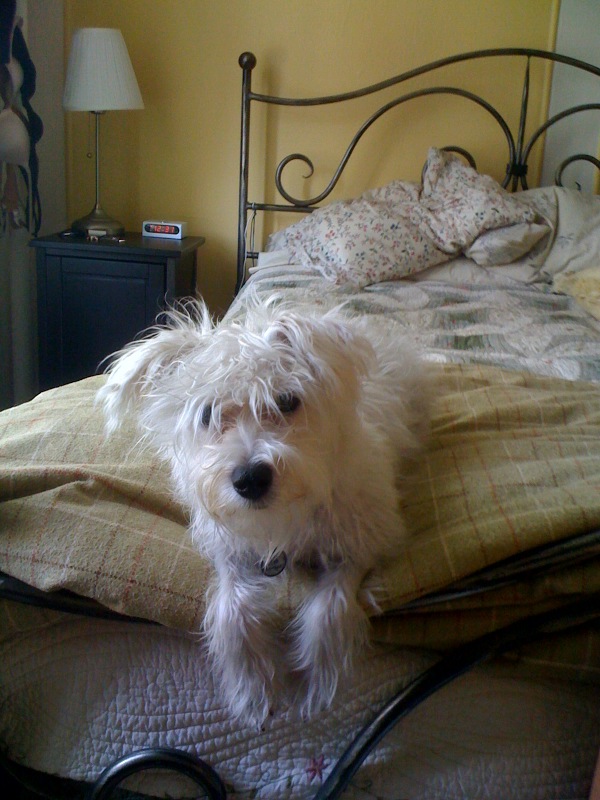
She likes to sit on the corner of my bed look out the window or watch me while I’m sitting at my desk.  She hovers with her paws over the edge of the bed frame, her head rested on them, looking at me.

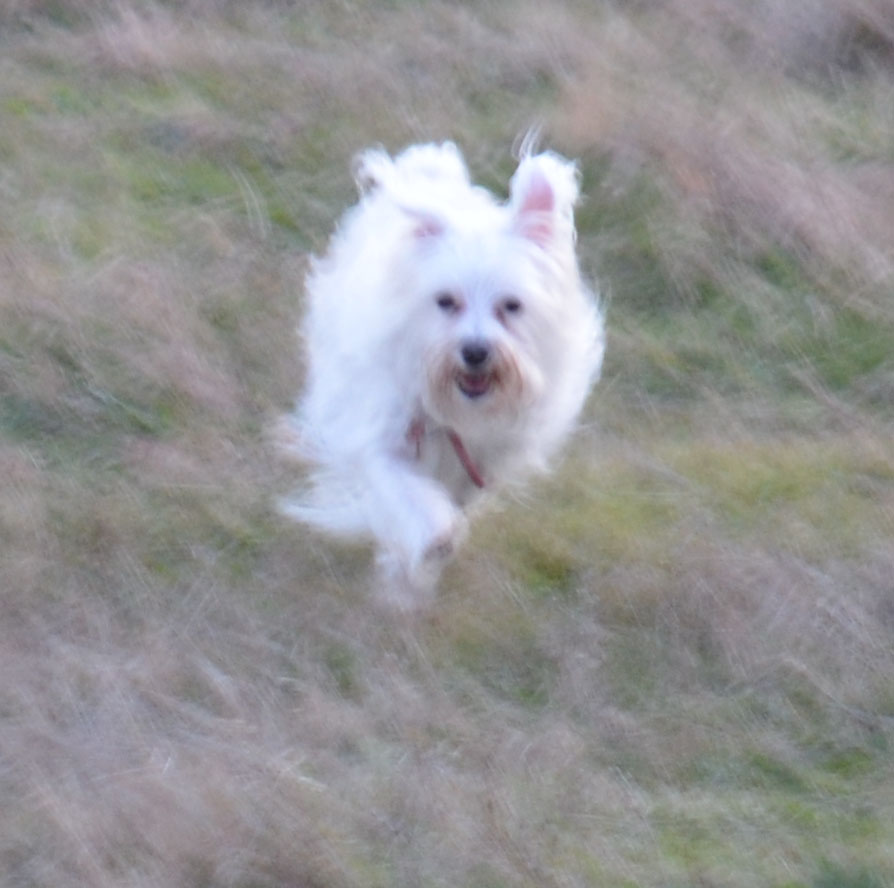
Ava makes distinct faces all her own.  The most common is what I call her happy face, her mouth slightly open, tongue out, eyes bright, often one ear cocked.  She’ll turn her head slightly as if to ask Do you want to play? In these moments I stop what I’m doing and play with her.

In the morning, when she wakes up, she has the most incredible bed head.  Her eyes are all sleepy, her hairs all akimbo.  She’ll crawl to the top of the bed, as if the effort is more than she can bear, then sigh and relax as we snuggle and pet her.

Later, wild dog comes out, chasing bears and fozzies, rattling them mightily from side to side until they are dead.  Sometimes she brings them to us and requests that we throw them.  We do, because watching her little sheep butt run away to get them is one of life’s greatest joys.  She does not like these stuffed creatures to see anything.  Within a half an hour of getting a new stuffed toy she removes its eyes.  Perhaps she does not want it to see her remove all its innards piece by piece.  More likely she loves that the pieces are hard and fun to chew.

After Ava has a bath she runs through the house like she’s on fire, ears back, bolting from room to room. What is that, dogs running after baths?  I understand their desire to rub themselves dry on the floor, but the running around after, I wonder why.  Almost every dog I have ever owned has gone running after getting a bath.  However, none of them have run like Ava does.  The others have all just gone for their run to dive into their rubs.  This one just runs like a bat out of hell from room to room, then comes and stares at me with the happy face, tongue lolling out, eyes bright. Then off she goes again to make another round.  It’s hilarious.

Ava isn’t thrilled with the bath itself.  She is actually one of the more obnoxious dogs I have had to bathe.  It’s a good thing she is small and easy to hold down because she really hates it and tries to escape.  Yet she is intrigued by the bathtub, or rather, people showering or bathing.  When Milla takes a shower, it is a guarantee that Ava will be in the bathroom standing on the edge of the tub, peeking around the shower curtain, her little sheep butt wagging its mini tail.  When either of us bathe, she comes and stands and looks in.  Maybe she is curious why we would want to do something so hideously awful.  Or perhaps she just wants our company.  Maybe it’s a little of both.

Ava truly loves to snuggle.  She is thrilled at her ability to jump on the bed.  She could not always do it by herself, but she grew and figured it out, and now seems to take great pleasure in both jumping on and jumping off. I can jump on the bed!  I can jump off the bed!  See?  I launch myself many feet past the bed!  Aren’t I skilled?

She will jump on the bed if I am lying there and come and lie across my neck and sigh.  She’s my little doggie stole.  She’ll snuggle there a while and get kisses from me, and strokes and rubs.  She knows I do not like her to lick me.  She does not even try anymore.  My ex-boyfriend lets her kiss him — I think it’s gross — but Ava knows he doesn’t mind so she licks him all over.  The only time she licks me is when I get out of the shower.  She will come in and lick the water off of my feet  until I dry them.

This dog makes me happy.  That’s the simple fact of it.  She came along when I was very sad.  There were so many reasons, many of them huge, for my sadness.  One the biggest was grief over the loss of the dogs who had lived with me.  I would have dreams about them, dreams they were still alive or still lived with me.  Vivid dreams.  Then this little dog came to live with me and I suddenly felt the desire to laugh again.  I laugh every day living with her.  She’s a happy, wonderful little spirit.  Frankly, I’m completely smitten.

Years and years ago, I may not have even been out of my teens, I read The Road Less Traveled by M. Scott Peck.  I don’t remember much of it at all.  I read it because it was a bestseller, and I don’t even recall its premise beyond the title.

However, I remember one thing vividly.  Peck argued that humans can never really love a dog, or any other animal, because to love as he defined it requires reciprocation in kind.  My feelings in response to his position are unchanged:  I wholeheartedly disagree.  Life is full of different kinds of love.  Some loves are equally reciprocal, usually with the person we choose as a mate, but also with certain friends or even family members.  By Peck’s definition, I could not truly love an infant or a small child or someone who does not love me back in the same way and with the same articulation.

What a limiting view of human capacity.  I absolutely loved my dog.  It did not matter that her adoration of me was different.  My love for her was there, and it still is.  Autumn was a gift and I will love her forever.  She helped to teach me selflessness.  She brought me joy.  She increased my humanity.  For this and so much more, I will be forever grateful.

Autumn

Autumn's Last Day

Autumn’s Last Day

Autumn — Chapter 16

Read Autumn — Chapter 15

I awoke one morning in early July 2005 and rose to give Autumn her shot. I called out her name, but she did not come. She was not at my bedside, and she was not anywhere in my room. She would usually get up to greet me and get her shot and food, because food was her favorite part of the day. I looked everywhere and was getting kind of frantic looking for her. Had she somehow gotten out again and I didn’t know it? I checked both doors, then headed towards the dog door to look out at the run. It was then that I saw she was lying in a heap of blankets on the back porch. I stood looking at her, my fist to my mouth, whispering, “Oh no, oh no, oh no. Not this. Not now. Oh, baby.” Funny, I had always pictured discovering her and running to her side, but I could not move.

“Autumn?” I queried. She remained still. Her ear stood on end. The light was the low, not quite sunny light of early morning in mid-summer. She was in a shadow. I stood back and could not move towards her. I was afraid she had died.

“Autumn,” I said. “Baby?”

I finally stepped forward and thought perhaps her ear had moved. Once I was within a couple of feet of her prostrate form, I could see that she was vibrating ever so slightly. I could see her breaths coming slowly, raggedly.

I knelt at her side and carefully touched her head. She was warm. Too warm. Her body vibrated, humming all over, like electricity was turned on inside her skin. Her eyes were glassy, staring at nothing. I was dry.

“Oh, baby. My baby.” I held her and stroked her, thoughts running through my head. What should I do? Who should I call?

I went into the kitchen, picked up the phone, and dialed Bjorn’s number at work. He answered and I could not speak. I could not emit a squeak. My voice would not come. I could not tell him what was wrong. Tears clouded my vision. The words were stuck.

He kept asking what was wrong. I finally managed to say, “It’s not Milla.” I meant that nothing was wrong with Milla.

He got the message because he said, “I know.”

I sobbed and finally told him that it was Autumn. After he told me this was probably for the best, I realized I had chosen the wrong person to call. Why him? Why on earth did I call him? I think on some level I wanted the closeness we never really had, wanted him to care about my grief and pain. During this crisis, I had a moment of absolute clarity when I realized that he would never be that person for me, ever.

I briefly told him what was going on, then got off the phone as fast as I could. I left a message at Dr. Fletcher’s office. Then I wondered, who do I call? I can’t call my mom; she won’t be a comfort either. I couldn’t call her.

Debbie. I realized then that Debbie was who I should have called all along. When I heard her answer the phone, I did not have to say anything. She knew it was me and she knew why I was calling her. There is a reason she is my best friend.

She asked for specifics. I told her how Autumn was. I told her I thought she would have to be put to sleep. I told her that I did not have any way to avoid my workday and would have to take her to Dr. Fletcher’s that evening because I could not get out of my work commitments. In spite of the fact I adored Dr. Horner, Ken was my friend, and I wanted him to be the one to put Autumn to sleep when the time came.

Debbie told me to keep her posted and stated that she and Robert would be there for me. She told me to let her know when I was coming down and when they needed to meet me there.

I was so grateful for her kindness and her calm. She put me at ease. As I spoke to her, I had filled Autumn’s syringe with insulin and given her a shot. I had given her some food. After the shot, she lifted her head and actually looked at me. Apparently the insulin had some effect, and quickly, because she was noticeably perkier than she had been.

It turned out to be a false alarm. Autumn gradually improved throughout the day and by the time afternoon rolled around and I could drive her down to the vet’s, Autumn had perked up significantly and was back to where she had been before the coma episode of that morning.

Dr. Fletcher patted her and gave her some string cheese. He always carried a can of the stuff to help keep pets happy in his office. Autumn gobbled at it.

“She’s not ready yet,” Dr. Fletcher said to me, patting her. I could see that. As prostrate as she had been that morning, she was back to her old self now.

We caught up on our news. Dr. Fletcher told me again that I should go to vet school, that I could have both law and veterinary degrees. We laughed together for a few more minutes before we turned to go.

“You’ve got some time,” he stated. “Not a lot, but some. Maybe a couple of weeks.”

Oh, I thought. Only a couple of weeks? I hoped with all my heart she would hold on just a little longer.

Autumn — Chapter 15

Read Autumn — Chapter 14

In spring of 2003, I graduated from law school. I studied for and completed the bar exam. After taking the test but before getting the results, I was hired by a law firm. Whether I would keep the job was contingent upon my having passed the bar. The firm was in NE Portland, a forty minute drive from our country suburb house in the middle of nowhere.

The reality of consequences was gradually squeezing me into the accepting that some decisions can impact a life for a long time. Less than three years earlier, during my first term in law school, I discovered with a panic that perhaps I had made a grave error. Yet the cost of that error was already well over ten-thousand dollars. If I quit, I would have to repay that sum, and if I wasn’t practicing law, how would I do that? And so I soldiered on.

My dismay grew the remainder of that year. However, second year was an improvement, and I began to believe perhaps the error was not so disastrous as I first thought. By graduation and beyond, I had returned to my original assessment, that I should never have gone to law school. Only after completion I was much further in debt, and much more discomposed. While I loved the academic rigor of law school, I was not enamored of the practice of law. I began to see the entire enterprise as one magnificent, horrendously expensive mistake.

Simultaneously, I was coming to terms with personal consequences as well. I knew three months after meeting Bjorn that we were not the most suitable pair. We were simply completely different. We could spend forty-five minutes arguing a point, only to discover we were arguing the same side. I was extremely energetic, always on the move, and constantly trying new things. Bjorn took life at a slower pace. He preferred hanging out at home and watching sports on television to buzzing around to various events. When we bought the first house, even though it was brand new, I wanted to dive in and start new projects, fixing it up. Bjorn liked it fine the way it was. About our only real connection was the love we jointly shared for our daughter.

Life was forcing me to take a good, hard look at the choices I had made, often on the fly, and determine whether a course correction was in order. I was driving nearly 45 minutes in one direction to my job. I didn’t hate the job, but I didn’t love it either, and making that commute seemed not worth it. I was living in a house and neighborhood with others who did not share my values, my politics, or much of anything except real estate. And sadly, I knew I was no longer in love with the father of my child, and nor was he in love with me. House linked to career linked to relationship, a concatenation of choices was leading me down the path to misery. Change was in order.

Bjorn and I had discussed ending our relationship several times over the course of a year. Early in the pre-dawn hours of the new year, after leaving a New Year’s Eve party at a friend’s house in Salem, the two of us were rehashing the menu from the evening as we drove along the winding country roads in the dark.

I was always the health nut, eliminating high fructose corn syrup and partially hydrogenated oil years before it became commonplace to do so. Bjorn liked junk food and fast food, and didn’t feel bad about it or any need to eat any differently. The party food had been mostly junk food and I was lamenting the lack of healthy snacks. I was also hungry.

“If you would just eat the junk, there wouldn’t be a problem,” Bjorn informed me, driving down the blackened, curved highway under the cold, winter moon and low, shredded clouds.

“I don’t have a problem,” I retorted. “We are just different. This is what I have been saying for months now. This is just one of many reasons why I do not think we are good together or for each other.” The passenger seat where I sat was reclined back, nearly touching the car seat holding a sleeping Milla. I slumped there, trying to make myself comfortable.

Bjorn didn’t say anything for a long time, such a long time in fact that I began almost to doze off. Then out of the silence he said, “You’re right.”

And with that, we ended our relationship of five and a half years.

Even though we were no longer a couple, neither of us immediately moved out and on. We had recently decided to sell the country suburb house and move into Portland. We had been looking for a house together, and I simply switched and began looking for a house on my own. Bjorn had been working as an engineer, but wanted to move into another area of engineering entirely, an area in which he was unlikely to find employment in the Portland area. He had begun sending out resumes to companies in other cities.

I wanted an old house, preferably a bungalow. I had been looking and looking, but this was the beginning of the housing bubble and prices were starting to get really steep. It was still possible to find affordable houses, but they usually came with another sort of price in that they were further out, in a less desirable neighborhood, or needed a lot of work. If it needed work, that was fine with me. I relished the opportunity. I was less willing to live further out, and I would not even consider some of the more troublesome neighborhoods because it would be just me and Milla living there. We had the dogs, but there was only so much they could do, and I didn’t want them to get hurt either. Often a neighborhood looked fine on the outside, but Portland had been experiencing an influx of Russian and Mexican gangs. No thanks.

After only a few weeks of searching, I found my house. Built in 1920, it needed tons of cosmetic work, but was structurally quite sound. With a few changes, the house would be perfect for us. It also had a lovely, floral back yard, as well as a side yard already fenced and lined with bark chips for the dogs. The support beams under the eaves were carved with loops and bows. This house was charming and perfect, so I bought it.

I had major plans for renovating and started immediately, before we even moved in. Bjorn moved to the house as well, and the two of us demolished the kitchen. It was the only place in the house that was truly awful. The counters were covered with tiny brown tiles that had not been installed properly. There was more grout than tile and each swipe of a sponge brought up a handful of dust, dirt, and goo.

In the four and a half years I lived in that house, I made many changes:  I installed an entirely new kitchen, put in a new kitchen window with rising double panes, to replace the former single-paned window that did not open at all, a travesty in a kitchen. I replaced the floors in the kitchen with new tiles. I removed the ugly, industrial grey tile in the bathroom, covering the floor with small, square white tiles. I removed a wall in the second room that opened into a small room with no real purpose, creating one giant bedroom. In that larger room, I installed a closet and discovered space above the stairs in the wall and turned it into a cupboard, using period knobs for the doors. I built a wall along the far side of the bigger second room, then opened a door into the master bedroom, creating a walk-in closet in a room that formerly had no closet at all.

While making the place for the door, I discovered newspapers from 1925 under the wallpaper advertising “Paris Frocks for Only $25.99!” I moved the front door from the master bedroom back into the living room where it belonged. I designed and installed built-in bookshelves in the living room, matching the woodwork at the base and along the top edge with the woodwork throughout the house. I painted the entire interior of the house with many lovely colors. I replaced all the light fixtures with period fixtures, and replaced a couple of windows that were no longer functional.

I also removed the jungle that covered the front of the house and built a rock wall, then covered everything in flowers. This was quite a chore as there was a 75-foot tall camellia bush that was so close to the house, it hung over the roof. I advertised the bush for free to anyone who would come and remove it. Two men arrived with a trailer and tools and excavated it over the course of a week, before driving it away on a flatbed trailer. There were also many scrubby azaleas who found new homes via the internet. For some reason, someone had installed sheep fencing in the front yard between the camellia and the maple tree near the sidewalk. Twisted and rusting, it was covered in ivy that used the sheep fencing as a ladder to higher reaches in the trees. All of it I removed and replaced with grass and smaller shrubs and flowers. I built a rock wall along the sidewalk, dragging the stones in three carloads from a rock quarry nearby.

Every job was done with the period of the house in mind, and in the end, it was charming and engaging. It was the perfect project. I did not have the money to hire contractors for most of the work, and therefore I did it all myself. I hired an electrician to replace the wiring and update that, and my dad installed the new bathtub fixtures and the front door, but everything else was done with my own two hands. It was a lot of work, but I loved that house and loved the end result.

Four months after I bought the house, Bjorn was offered a job in Florida doing exactly the kind of engineering he wanted, designing medical implants. Within three weeks of the job offer, he packed his truck and set off, leaving me alone with our daughter and the dogs.

On the one hand, I was relieved to let go of the tension between us. On the other, life became much more difficult. First there was the house. Even though it was a project of love, it was still a lot of work, especially for a full-time, working single mother. Milla was attending kindergarten and would go to aftercare there after school. Because of the hours at aftercare, I had to cut back one hour per day at the office, leaving at 5 instead of 6. This did not change my workload, only the hours I sat in the office doing it. In spite of the fact that the workload remained unchanged, the firm cut my pay, which I could barely afford.

I was also now the only person available to ensure Autumn was given her daily insulin shots twice every day. No matter where I was in the evening, I had to plan to ensure Autumn was medicated. I chose 7:15 as the time for these shots because it was early enough in the morning that I had not yet left for work, late enough that it would not be horrible to wake up to on the weekend, and early enough in the evenings that I could still do something after.

At times, I would take her with me in the car if I had to be somewhere and could not be home to give her a shot, a cooler in tow for the insulin, which had to be refrigerated. I also had to be careful not to shake the bottle because this could cause the insulin to become unstable and unusable.

In spite of the difficulties, we managed and forged a comfortable routine. Six months after Bjorn moved away, I left the firm and started my own practice. This brought its own stresses, but it was still easier setting my own time and getting work done at odd hours. I was freed up to attend more events at Milla’s school during the day, and it gave me much more flexibility for dealing with Autumn.

Over the next year, we settled into our lives with Bjorn far away and working at my new practice. I worked on the house on weekends and some afternoons during the week.

I took both dogs out of the house nearly every day. We lived near a dog park with a wide field where the dogs could run without leashes. Even on wet days, I would go and let them romp in the muddy grass, then wipe their paws before having them ride in the back of the car to home.

Autumn couldn’t get up into the car by herself, so I would lift her and get her situated. She would ride, watching the world go by, tongue lolling, ears perked, her happy face on. She loved car rides. Molly didn’t mind the car, but she preferred curling up in the corner or on the back seat.

Autumn actually didn’t seem to notice the poking of the needle into the skin at the back of her neck anymore. Every shot was followed immediately by food and she soon figured out that my shuffling around in the refrigerator door meant food was soon to be had, so she would wait right at my heels, eyes up, perky and expectant, waiting for that shot.

Needles. The funny thing about giving a shot is that the first few times you do it, it’s terrifying to think of the pain it’s inflicting. After you’ve given fifty shots, then a hundred, then several hundred, you can do it in your sleep. I suppose it’s like that for anything new. There is just something rather odd about doing something that becomes so familiar that is actually poking into another living body.

I will never forget those little orange tipped needles. I bought them in bulk from various pharmacy stores. I got to know where the deals were. The shocking thing was the difference in price from one store to the next, for the exact same needles of the same brand. It gave me some insight into what diabetics or others with chronic medical conditions face every day. The same box of needles would be ten dollars less than the cost somewhere else. The cheapest I found were about $17 for a hundred needles (they had to be thrown away after each use), but I found places that sold them for $33 for an identical box. I had the benefit of being strong and fit, so driving to another store where I knew the needles were cheaper was a fairly simple proposition. I could see how a mostly housebound senior would have a lot of difficulty shopping around.

After administering shots to Autumn twice daily for over a year, giving the shots became mundane and completely routine. On weekend mornings, I would wake up, stumble to the kitchen, roll the bottle in my hands, pull the shot, give it to her, feed her, and head back to bed, all in about three minutes flat. I don’t think I even really woke up. All the dogs knew the wake-up time, and if for some reason there was no alarm and I failed to awaken, one of them was guaranteed to rouse me from sleep.

One morning on a Saturday, I staggered into the kitchen, pulled the shot, and the phone rang. I squinted at the caller id, wondering sluggishly who would call at 7 a.m.on a Saturday. There was no way I could read the screen. I am ridiculously farsighted and my eyes were full of sleep.

I answered the call. It was Officer So-and-So from the Milwaukie Police Department. Did I have a golden colored dog? I informed him that I did, looking blindly around the kitchen for the neck I’d planned to shove a needle into not thirty seconds previously.

The officer went on to say that a yellow dog had been seen “wandering in a daze” down the road. She looked lost and starving. He responded to the call and found my number on her collar. He offered to bring her to me.

I explained that she had diabetes and that this was why she was so thin, that I had no idea she was out, that she was an escape artist of the highest order, and that I would be most grateful if he returned her to me. And please, I begged, don’t feed her anything.

Five minutes later, Autumn walked in the door, that diabetic-glazed look in her eye. I poked the shot into her neck, barely glancing down, I had done it so many times. I talked to the officer for ten more minutes, telling him Autumn’s story and about her magical ability to get out of the yard, and thanked him profusely as he drove off. I did not mention that I had failed to replace her underground fence collar after her bath the previous evening.

I was grateful Autumn was back, but I was really glad I did not get a “Dog at Large” ticket. Those can be expensive. I knew. Autumn had given them to me before. Even though the dog yard was fenced with underground wiring, it did not guard against escapes out the front or back doors, and I lived with a 5-year-old who had a habit of running out without making sure the latch had clicked. Autumn knew this and followed Milla around, waiting for any opportunity to slip out the door.

I was also extremely grateful he had not given her any food. On one occasion when Autumn escaped, a well-meaning yet misguided neighbor fed her two huge bowls of food before she keeled over in the woman’s kitchen. Why she waited to call me until after giving my dog a meal I’ll never know. Maybe she thought I was starving her on purpose or something, as if someone who was careful enough to tag a dog would be careless enough not to feed it.

In any case, when I went to retrieve Autumn from the neighbor’s house, the lady started to scold me for letting my dog get so thin, but I cut her off and explained that she had a chronic illness and that the food she gave her could have killed her, which is why she had keeled over.

I wanted to scream, “Why would you feed someone else’s dog, you idiot?” but did not. She didn’t know, and she thought she was helping. I used my glucose monitor to check Autumn’s blood. I ran the test, gave her an insulin shot, and she was back to normal within a half an hour. After that incident I went to the pet store and bought a tag that read, “I have a disease. DO NOT FEED ME!”

The glucose meter was a godsend and really the only part of all the illness-related activities Autumn endured that she seemed really to abhor. Other than testing urine, it was the best way for me to get a reading on Autumn’s insulin levels, especially if she had broken into the trash cupboard and found something to eat, or escaped and gotten something.

We had a strict food routine in the house whereby any food-based garbage went into the compost bucket, which was kept on a high shelf with a lid. When it was full it went into the compost bin out back, away from the dog area. The rest of our waste was separated into two containers, one for trash and the other for recycling. Autumn loved to get into the trash version and lick through whatever was in there, such as butter wrappers or soiled plastic wrap. Once the new cabinets were installed in the kitchen, I put in a double-garbage-can rack, placing the recycling in the front bin, and the trash in the back. There was a childproof latch on the door. When that was closed and the trash in the back, she was not able to get into it. However, Milla had a knack for leaving the door open and the whole thing pulled out. Autumn would then remove the can from the rack and go through whatever was inside.

One time shortly after we moved in, I arrived home to discover that Autumn had gnawed through the bottom corner of one of the kitchen boxes sitting stacked and unpacked on the kitchen floor. She had discovered all the dry good baking items and ate them. Molly had joined in on that escapade. I caught her because I discovered powdered sugar on her ears and muzzle. Naughty things.

Another time both dogs managed to get onto the table and eat a pan of chocolate cake.  I had heard the warnings that chocolate supposedly killed dogs, but this simply was not the case.  I read somewhere that it was only dogs who had an allergy that had to worry about eating it, but who wants to be the person making this discovery the first time?  It makes sense to keep the chocolate away just in case your dog is the one who is allergic.

However, potential life-threatening allergies did not stop my dogs from climbing on the table and eating an entire chocolate cake.  When Dan and I lived at his parent’s, Murphee climbed onto the island in the kitchen and ate a pan of brownies.  In all cases the worst thing that happened was the dogs came away with some really nasty gas, and we no longer had any dessert.  Apparently none of them suffered from chocolate allergy.

The glucose meter was a big help for these non-diabetic dog food eating sprees. However, in order to use the meter, I had to obtain a drop of Autumn’s blood. One end of the meter had a sharp lancet with which to pierce her skin. At the other end of the meter was a test strip onto which I smeared the blood to obtain a glucose reading. Autumn hated the pricking part. There was not any part of her body where it was easy to get a blood sample, mainly because she was furry. Only her lips and the pads of her paws were bare. The lips had to hurt; she yelped whenever I tried drawing blood from them, the skin was so thin and soft. But the pads of her paws were thick and extremely difficult to pierce enough to get blood. When I was able to poke them hard enough, it usually caused way more bleeding than was necessary for the meter, and this made her cry out as well. Digging that deep into the pads was painful. For this reason I only used the test when I knew she had eaten something she should not have. In addition the test strips were really expensive, so I didn’t want to use them up quickly. Humans would use the meters daily, because they could control their levels fairly precisely with diet. Autumn could only eat her prescription diabetic dog food, so it wasn’t necessary to monitor all the time.

Autumn was always so patient with the medical interventions she had to endure, but the lancets and subsequent rubbings were the one procedure for which she refused to sit still or comply. She would pull away and yelp, making it that much more difficult to get blood. But she was a dog – as much as I told her it would all be over soon, she just couldn’t get it. Sometimes I would be frustrated because she had gotten into something and made a huge mess, and then wouldn’t sit still so I could check her blood.

“If you wouldn’t get into anything, I wouldn’t have to do this,” I would scold, obviously more for my benefit than for hers.

I would read the meter and if the levels were high, give her more insulin. On occasion, the meter simply read HI, in its blocky digital letters. This meant her glucose levels were so high, they were off the chart, and insulin was required immediately.

Within a few months after her diagnosis, I noticed tiny white flecks in Autumn’s eyes. The flecks increased as the weeks progressed. I went online and discovered that Autumn was developing diabetic cataracts, a condition that is extremely common. I read somewhere that 75% of dogs with diabetes develop cataracts, and that their presence did not necessarily imply glucose levels were not under control.

In a normal eye, the lens is round, clear, and hard. It is connected by fibers that move so the eye can focus. It is enclosed in a capsule and gets fluids from the eye. The lens does not have its own blood supply. One of the fluids the lens absorbs is glucose. If there is too much glucose, the excess is converted into the sugars sorbitol and fructose. Sorbitol and fructose pull water into the lens which makes the lens cloudy, and a cataract is formed.

Some dogs develop complete cataracts fairly quickly after their diagnosis. Autumn’s developed slowly in comparison to some of the stories I read, and her cataracts were never completely solidly white; they were slightly less opaque than that. However, a year after the diagnosis, she could not really see. She would tilt her head and look at me as if she were peeking out the side of her eye, trying to see around the cataract. A couple of times she ran into the doorframe around the back door, but she quickly adapted and learned where her world was at. I could have had the vet perform surgeries to remove the cataracts, but we discussed it and ruled it out. The cost was over $1000 per eye, and the average life span of a dog with diabetes is two years from diagnosis. Even if Autumn lived another three years, the result did not justify the expense or the upheaval of a surgery. Blind dogs adapt quite well to living without sight, and Autumn was no exception.

After Autumn had been living with diabetes for nearly two years, she was almost completely blind, but she was lively. I would take her to the dog park and throw frisbees and sticks for her. I would set her up, touching her muzzle with whatever I was throwing, then guiding her head in the direction of my toss. Autumn would head out and look until she found what I’d thrown. Her sense of smell was fully intact, and she would find anything, no matter how far I had thrown it, as long as I pointed her in the right direction. She loved the game, turning and running right back to me to throw again, in that familiar trot she had inherited from Cody. She wore out easily though, and would lie down to shred the stick after only three or four passes letting me know she had had enough.

Read Autumn — Chapter 16

Autumn — Chapter 10

Read Autumn — Chapter 9

The spring Milla was born, we decided to move to Portland. Living in Corvallis had worn thin for me. It was too small and too far from the activities we enjoyed. I liked bigger cities and had mainly stayed in Corvallis because first Dan, then Bjorn attended university there. Bjorn had grown up in a suburb of Portland, and during a visit shortly after Milla’s birth, we realized we could move.

I remember clearly the moment it occurred to me that we could leave Corvallis and live somewhere else. We were driving along in the car in Portland near Bjorn’s childhood home. I was a passenger in the back seat next to the baby (because I was always a passenger in the back seat next to the baby), and as we slid past orchards and neighborhoods, the idea we could actually leave where we were and go somewhere else popped into my head, and I said to Bjorn, “Let’s move. Let’s move up here now.”

Milla wasn’t even yet a month old, but I wanted a change, wanted out of Corvallis with its memories and limitations. Bjorn had one year left towards his engineering degree, and I was planning to apply to law school. We held a garage sale, packed a moving van, and headed north. Autumn was six years old.

We started out renting a room in Bjorn’s dad’s house, but this proved unsatisfactory nearly immediately. I had learned the hard way what living with family can do to a relationship, and within a month we had rented our own apartment on the third floor of a complex that had been, only months before, a filbert orchard. There were still filbert orchards across from our apartment, and we taught the dogs to run out the door, down three flights of stairs, and out across the median to the trees to do their business.

In spite of the fact the apartment was rather small, near Christmas the year we moved in, my brother Derek asked if he could stay with us for a short time while he looked for a place to live.  He had been living with our parents in Jefferson, a town about sixty miles south of Portland.

For years, Derek had struggled with drug addiction.  He would go to treatment, move out on his own and get a job, then for various reasons end up back living with our parents and near the people who always helped him get into trouble.  This cycle had run through about four times at this point.

At the time Derek wanted to live with us, he had been back to our parent’s, and we all believed that if he could just get away from the area, he would have a better chance at success in beating his addictions.

Bjorn and I discussed whether to allow Derek to stay with us.  Bjorn actually didn’t have any problems with it, but I was worried if we allowed him to stay, we would have a difficult time getting him to leave.  Unless he did something awful, I didn’t want to have to call the police simply to get him to move on.

We finally decided that we would allow him to stay, but with certain limitations.  Namely he had to get a job and he could not stay with us longer than two weeks.  We also did not want his girlfriend to live there.  Neither of us I liked her very  much, but we did not tell Derek this.  Even if we had loved her, we simply did not have the room.

Derek moved in. We let him sleep on the couch and keep his belongings in Milla’s room because she slept with us in our bed.  Nearly immediately, he was able to secure a job during the swing shift, so we didn’t see him very much except in the late morning before he left for work.  One afternoon when he did not have to work, I took him over to the management office to help him fill out an application for an apartment of his own.

For Christmas, I invited my parents and my sister and her family to our house for Christmas.  The apartment was tiny, but I had decided after Milla’s birth that we were not going to do the usual holiday run-around anymore.  On Christmases past, we would drive to my parent’s, then Bjorn’s dad’s, then his mom’s family, and often to my sister’s, or some other version of it.  No one ever came our way.  I did not want my baby to spend her holidays driving all over the place.

We pulled out the leaves to the table and made room for everyone. The kitchen was not large, but it served its purpose, helping us to serve dinner to eleven.  Once the family was satiated, we all opened gifts, our families left for home, and I straightened up the mess.

For years I had gone to the movies on Christmas day, me and many others.  Apparently Hollywood figured out this trick because movies started opening on Christmas, which was great since we saw a lot of movies and frequently needed new choices.  During movies, I would breastfeed Milla and she would fall asleep in my arms.  Derek was with us so we all bundled up and headed out to the car and off to see a show.

Three hours later when we arrived home, things were not in order.  We had only opened gifts for my family and one another, but there were still many gifts left for Bjorn’s family and for our friends.  The wrappings to most of these gifts were now spread throughout the house.  Little pieces of ribbon, bows, wet wrapping paper, and tags lay everywhere, in the living room, across the rug in the dining room, down the hall, and in both bedrooms. The cork stopper to a jar of nuts was half shredded, bits of cork speckling the carpet.  Pieces of candy cane were littered everywhere, the chunks obviously sucked on because they were coagulated in their plastic wrap.  A thorough mess.

Normally if we had arrived to a scene like this, Autumn would be standing happily in the middle of it, tongue out with some incriminating evidence on her muzzle, and Molly would be hiding, but both dogs just stood there, looking at us.

“What in the world is going on?” I asked them sternly, knowing of course there would be no response.  “Did you eat our gifts?”

Looking further, we discovered several food items in the hall and in our bedroom.  It did not look like much was eaten, but they had certainly seemed to have had a party opening all the presents and spreading them all over the place.

“What in the world were you thinking?” I hollered?  “Why did you do this?  Do you really think I want to clean up a mess like this on Christmas?”  They ignored me.  Neither of them seemed in any way concerned, which for Molly was completely strange.

I began picking up the pieces and pulling the presents together to rewrap.  Bjorn and Derek took the dogs out on our patio to keep them from getting into anything else.

It wasn’t until years later, after Derek had been to rehab a couple of more times, and long after Bjorn and I were no longer a couple, that I learned the real truth of what happened that night.

Apparently my brother had hidden in his backpack a rather large, brownie-sized cake of hashish.  When the four of us returned home to the mini Christmas disaster that night, Derek quickly realized what was up.  His bag was askew, the pocket in the front of the bag where the hashish had been stashed wide open.  The hashish had been wrapped in aluminum foil with a sticker on the front that read Acapulco Gold!  This foil was lying smashed and spitty in a pile on the cream-colored carpet, the Acapulco Gold! label torn in half.

Derek immediately pulled Bjorn aside and told him he thought the dogs had eaten his hashish.  The two of them dragged the dogs to the patio to confirm their suspicions.  Apparently what I failed to notice was that our dogs’ pupils were the size of platters and rimmed in red.  The reason neither dog had reacted in any way to my tirade was that they were both completely stoned.

When I heard the story, so long into the future, I laughed, recalling the picture of both dogs baked and confused.  I can only imagine how it must have been from their perspective, discovering Christmas goodies while they were high on hashish.

Yet Derek and Bjorn were right that I would have blown a gasket if I had known at the time. Even later, the implications were not lost on me.  Derek had kept drugs in our apartment, and had done so with our small daughter there.  She was mobile by then, crawling about and getting into things.  He assured me the stuff had been zipped up tight in his bag, and that Milla would never have been able to find them, but his concealment had not been enough to keep our dogs from making their discovery.  They were very lucky they didn’t get sick.

Ultimately, Derek fulfilled his end of the bargain.  He moved into his own apartment in the complex and got a job.  His story then continued on its own trajectory.

Meanwhile, Bjorn and I were both ready to move less than a year later.  The apartment was so tiny and located in a suburb that seemed designed to stop all drivers at every traffic signal, which drove me crazy. It was also too far from the university where Bjorn attended classes and the law school where I planned to attend classes a year later. I wanted more than an apartment. I wanted a yard where the dogs and baby could play. I wanted space, and not to be able to hear our neighbors arguing.  Bjorn, nearly 6’7″ in height, wanted room to stretch his legs without banging them on another wall. And so, less than a year after moving north to Portland, we moved again into a high-ceilinged duplex with a rambling yard. An ancient oak shaded half the yard and kept our home cool.

I loved that duplex. Too bad there were drug dealers in the park next to it. We could hear shouts and shots and all sorts of unmentionables there, at all hours of the day and night, which frightened me somewhat, considering the blonde, curly sprite living with us. The dogs also barked at all hours, warning off interlopers, causing us all to jump as we studied and played.

Finally, after witnessing a police officer throw a half naked woman and several baggies filled with white powder across the hood of his patrol car, cuffing her and tossing her carelessly into his backseat, we decided that it might be best to move on yet again.  During the years Bjorn and I were together, we had a knack for moving into places that suited one need and not another.

Our next choice was the perfect little farmhouse. Charming and comfortable, the house was yellow with white trim, and sat on two acres in the middle of one of Oregon’s wealthiest suburbs. The acreage was grandfathered, allowing us to keep livestock, so we fenced it and brought home my old childhood pony, as well as some ducks. We could have stayed there forever. Unfortunately, the little house was a rental and the manager a son who was waiting with bated breath for his mother to pass so he could develop the property, which he did not long after we moved out. There was a five-story cherry tree in the front yard, which was promptly chopped down, along with the house, in his zealous desire to destroy the land and fill his greedy hands with cash.

Our next place was our first purchase and horribly ill-suited for us, too far from town, and too much suburban sameness, block after block. In purchasing this house, Bjorn and I took the advice of a well-meaning, but misguided friend who assisted us in making the purchase. It was only years later after Bjorn and I broke up that I finally bought a house that was suitable to me. We learn with age that which we will no longer tolerate.

However, at the time we chose the duplex, we were a long way from buying our own home. Bjorn was in his last year of school and I was in my first of law school. We both worked and studied and parented our child. The duplex was spacious and shared only a small wall with our quiet neighbors. Built in the sixties, it had sloping, vaulted ceilings and two bathrooms. After the dinky, third-floor walk-up, this was paradise!

During our move from the apartment to the duplex, I saw a sign over the mailboxes at the apartment complex advertising a free cat. According to the sign, the cat liked children and other pets.

Milla and I headed over to visit the prospective cat. The apartment was on the third floor. The people who owned the cat ran a daycare service out of their home. The lady of the house wanted to find the cat a new home because her husband would not allow the cat to come into the house, and he had therefore been living on the balcony for his entire short life. She had gotten him from the humane society when he was a kitten. Except for a few visits with the daycare children where he was dressed in doll clothes and pushed around in a stroller, he had spent eleven months living on a 3 by 6 balcony with one other cat. His name was Friday and we fell in love with him on the spot.

For the rest of his life, Friday adored us. I swear he was grateful to his bones we had released him from the prison of that godforsaken balcony and the daycare children dressing him up in baby clothes.

Autumn had never been a big cat chaser. There had been cats living at the apartment complex in Tennessee and in every neighborhood we had lived in since. She and Molly were both nonplussed by the newest member of the family. After some initial sniffing, the three all ignored one another.

I suppose after Milla, as far as the dogs were concerned, any new family members were acceptable. The two of them had both settled into life with a tiny person running around. First she was a lump they could sniff and mostly ignore, but then she began moving about and carrying food with her, and suddenly she was a much more interesting prospect.

They also relished her diapers. Their’s was a disgusting and foul habit, this desire to eat diapers. No matter what steps we took to keep used diapers away from them, they would somehow manage to get into them and eat them. This would be followed by yellowish turds filled with chewed up plastic and diaper innards.

We had purchased for Milla’s room a widget called a Diaper Genie. The thing had a weird hole in its top through which one placed a used diaper. The diaper would slide through a convoluted plastic contraption and into the bowels of the Genie. A door on the front of the Genie allowed access into the bag which held the diapers. Its point was to ensure that the smell of the diapers did not escape into the room where the Genie was placed.

Both our dogs could open that Diaper Genie and get the diapers out. We would come home from wherever we had been to discover diaper shreds, baby shit, and pieces of soiled diaper spread from one end of Milla’s room to the other. Molly, of course, would be hiding in our bedroom under the bed because, in spite of her biological urge to eat diapers, she knew that our discovery of them would result in lots of hollering and hand-wringing, and this terrified her half to death. Autumn would sit among the diapers, her tongue lolling, breath smelling foul and wrong, wondering where she could find some more.

We attempted to avoid this problem by placing the Diaper Genie into the closet in Milla’s room. To no avail. Autumn was always a clever getter into things, and she would simply open the closet and proceed to dismantle the Genie in there instead.

Finally, I went and purchased an industrial strength, outdoor garbage can, the kind with a lid and bungee cords for closing. We put the Diaper Genie in this, put the whole contraption in the closet and, as long as we remembered to keep Milla’s bedroom door shut, the closet door shut, and the lid on the industrial garbage can securely fastened, we could avoid diaper catastrophes. It was also imperative that we remove the filled bag from the diaper genie to the outdoor garbage can once it was full. On a couple of occasions Bjorn left the full bag on the floor in the bedroom, which may as well have been a giant, flashing invitation to the dogs to come in and have a diaper smorgasbord at their pleasure. It only took a couple of misses on this one for Bjorn never to make that mistake again.

Milla celebrated her first birthday at the duplex.  I invited our family and our closest friends to a little garden party.  I baked a cake that looked like a caterpillar and covered it with fondant.  I sat up half the night stringing together green and yellow, construction paper, daisy chains, which I hung all over the kitchen and living room.  Clearly, Autumn’s birthday parties were just a warmup.

Within weeks of her first birthday, Milla walked across the living room.  She had been cruising for a while, walking everywhere as long as her hands held a couch, the wall, or some other support.  Then one afternoon while holding a marbly green, plastic ball, she took off and walked twelve steps across the room.  It was as if the ball were her support.

Once she began walking, she kept going, and only became faster.  Up to this point, the dogs were interested in her usually only when she sat in her high chair.  Both Milla and the dogs had discovered that the high chair could be quite fun.  Milla would toss whatever food item she happened to be consuming, and then laugh hysterically as the dogs pounced on it like starving lunatics.  Occasionally this would cause arguments between the dogs, which only made Milla laugh more.  First lessons in cause and effect.

During her crawling phase, when things became a little too silent, I would often discover her on all fours, both hands in the dog water dish.  She was also quite fond of making dog food soup, mixing together whatever food stuffs were left in the dogs’ dish with their water.  I kept the dishes on a place mat in the kitchen, and after these escapades, the floor around and under the mat would usually be a watery mess.  Autumn especially loved eating the soupy mixture, and would wait to one side while Milla mixed it for her, then dive in as soon as the baby crawled off to explore elsewhere.

When Milla began to walk, she also began to carry different food items with her.  I usually put her in her high chair to eat, but sometimes, especially if I was busy trying to study or straighten the house, I would pour some cereal in a little dish for her to carry around, or give her a cracker.

One night I sat at the kitchen table studying.  Milla had finished her dinner, but was wandering around with a sandwich in her hand.  Molly was hiding under the dining room table, doing her best to remain as unobtrusive as possible.  Autumn, of course, was following Milla, trying to get the sandwich she held in her hand.  Milla kept telling her “No!” and holding the sandwich up, trying to keep it out of Autumn’s reach.

Finally, frustrated at her inability to get the food, Autumn jumped up and tried to grab the sandwich, snapping at it, shoving Milla backward into the cupboard.  Autumn tried again to snatch the sandwich, but she got Milla’s cheek instead, high up, underneath her eye.

Milla cried out in pain.  I jumped up and raced over to her, shouting, “Autumn!”  Autumn ducked and backed up as I gathered Milla into my arms, sobbing.  Bjorn raced into the kitchen, screaming “Autumn” in a loud and ferocious voice.  He grabbed her by the ruff of her neck and threw her across the room.

“I could kill that dog!” he shouted.

“Leave her alone,” I screamed.  Milla wailed.  “She was trying to get the sandwich.  It was an accident.”

“I don’t care if it was a fucking accident,” Bjorn raged.  “She bit my daughter in the face!”

“It wasn’t on purpose.  She just wanted the sandwich,” I answered.  Milla hugged me and sobbed in my arms.  I grabbed a washcloth and set her on the counter to investigate the damage.

“Go get some antiseptic cream,” I instructed Bjorn, hoping that a project would separate him from his anger.  He stalked out of the room to go search for the medicine.

I wet the washcloth and gently rinsed Milla’s face.  She had suffered a small scratch under her right eye.  Thank goodness the bite was on her cheek and not her eye.

I looked around to see where Autumn was at.  She was cowering in the corner near the glass back door.

“Autumn, it’s okay,” I cooed to her.  “I know it was an accident.”  She was trembling.  I opened the back door and let her out.  From wherever she had been hiding, Molly came running and scooted out past me as well.  Neither dog was comfortable with yelling and violence.

Milla calmed down.  I swabbed some ointment on her small wound and then took her into the bedroom to nurse.  She was none the worse for wear, but Bjorn was still quite angry, and never forgave Autumn for this bite.  For days he told anyone who would listen that he should have killed my dog.  Eventually his anger wore down, but I made took extra care with Milla and food to ensure nothing like this event ever happened again.

Read Autumn — Chapter 11

Autumn — Chapter 9

Read Autumn — Chapter 8

Despite the fact that Dan and I had spent almost two years in couples counseling, the combination of marrying young and living with family had taken its toll on our marriage. As is often the case, there was also a strain between my desire to start a family and Dan’s desire to wait. As his final year at the university wound down, we decided our marriage was over.

We had moved from the apartment to a tiny little house with a small yard, a minuscule garden, and a park nearby for the dogs to run and play. Dan moved out of this little house and back into his parent’s, but would visit with Autumn every so often. He had been offered a job in California, and I think he knew that after he left, he might not see her again.

I remained in Corvallis with Autumn after Dan moved away. Over the next year, I dated a few different men, and eventually met another man named Bjorn. Without intending to quite so soon, our relationship became much more serious than we intended when I discovered I was pregnant. While I was concerned about an impending pregnancy with a man I had only known a few short months, I was also delighted. I had wanted a baby with Dan, but he had not wanted to start a family while he was still in college. Bjorn had two years left before graduation, but when I informed him I was pregnant, he was as excited as I was.

How does one explain circumstances about which one is certain to be judged by a segment of the population? I wasn’t as circumspect as I could have been. I certainly could have made choices that to some would have seemed wiser. Yet I have no regrets; once the seed of my child was planted, I would not have changed a thing that could have arrived at a different result. I knew three months into the pregnancy that I would have ended the relationship with Bjorn sooner rather than later – we were completely incompatible in many ways. But after my baby was born, and even before when she was a minuscule mass of cells clinging to the inside of my body, there was no way I could imagine my life without her.

The months I was pregnant were emotional, both up and down. In retrospect, I realized I was mourning the loss of my marriage and the friendship I had carried for over seven years, while I was simultaneously intoxicated with the joy of expecting a new baby. It was a paradoxical place.

Prior to my pregnancy and after Autumn had decided she was no longer interested in going for runs with me, I would take Molly running or roller-blading, then take both dogs to the park near my house to run and play. When the weather was warm, I would take Autumn swimming. She was extremely healthy. After having spent several years swimming in the summers, she no longer displayed any signs of hip dysplasia. She was quite active, and though not as lithe as Molly, she was definitely athletic and capable. After I became pregnant, I stayed active, walking both dogs, roller-blading and running with Molly for as long as the pregnancy would allow, and riding horses well into my sixth month. The dogs enjoyed the exercise. As the year wore down from fall to winter, we all settled in, expectant and waiting for the enormous change due in spring.

Both of the dogs were big shedders. In spite of the fact that I vacuumed at least every three days, there were always puffles of fur in the corners, under the furniture, and in my bedding. I would joke that I could collect this fur and make a pillow out of it, there was so much.

Bjorn and I had moved into an apartment together. The little house I lived in first with Dan, then by myself was simply too small for our family. As the time grew nearer for our baby to arrive, I began nesting in earnest, cleaning and vacuuming. As my due date loomed, I became nearly frantic with the desire to move about, wishing I could run or ride my bike as I had before the pregnancy.

I awakened the first morning of May and wanted to get out of the house, in spite of the fact that I had expanded beyond any notion of comfort. I had heard that walking could help bring on labor so I was headed out. I grabbed my purse, keys, and the dogs and jumped into the car, Bjorn trailing. The local kennel club was sponsoring a pet day fair. At the fair, hawkers sold kerchiefs, dog toys, leashes, and other assorted canine goods. We wandered for a couple of hours, until my hips could no longer tolerate my weight and the heat. It was a warm day for early spring.

We spent the rest of the day out and about, doing our best to encourage baby’s arrival. It must have worked, because shortly before midnight, my contractions began and increased. At 12:24 p.m. on May 2, 1999, Milla Elina was born.

The two of us had arranged with my best friend Debbie and her husband Robert to take care of our dogs while I was in the hospital having the baby. They were parents to a kitty named Misty and completely understood the relationship I had with my dogs – as far as we all were concerned, the dogs were surrogate children and could not be left to fend for themselves for two or three days.

In spite of the love I felt for Autumn and Molly, I was unprepared for the tsunami level of emotion I felt toward my infant daughter. It was all consuming. I suppose this connection is nature’s way of ensuring the survival of the species. I was in such love, such infatuation, such complete adoration for my child, I could not understand why everyone wasn’t having babies. I walked around for weeks staring at everyone thinking, “You were someone’s baby! Someone loved you like this!” Only later as the hormones wore off did I understand intellectually that some people never feel like I did, but I could never understand it in my heart. I loved my child with my whole body, mind, and spirit.

When I came home from the hospital after giving birth to Milla, Autumn kept trying to get up in my lap, to get near me, but I was afraid she would hurt the baby. I had sworn before giving birth that I would not become one of those people whose dogs disappeared into the background, forgotten and forlorn, but during the first few days home, I did just that. Once we were used to having the baby around and had settled into a routine, I shifted back and Autumn became part of my attention circle again, but I’m sure the first couple of weeks were very hard for her. I imagine in some ways this is how it is for older children when a new baby is born, especially when they are very close together in age. There were fifteen months between my sister and me, and when Milla was fifteen months old, I could not fathom bringing home another infant. She was still very much a baby. People do it, but it must be hard.

Bjorn and I decided that Milla would sleep with us. We bought a pillow with a curve in it and placed her between us on the queen bed. Those first nights were difficult, mainly because little Milla kept getting dog hair in her nose, making it hard for her to breathe. In spite of all my cleaning, there were still dog hairs in the bed, and they would stick to Milla’s little nostrils, causing her to sneeze and cry. I had thought we could manage allowing the dogs to sleep on the floor next to the bed, but that first night they kept trying to get on the bed and get near me. Bjorn would yell and shove them hard onto the floor.

It pains me now to know that I did not do more to stop him. I felt so exhausted and physically worn out. It breaks my heart that I let him treat both of my dogs that way and especially Autumn. I can only imagine what it must have been like for her. She had lived with me her entire life, nearly six years, and this man who had arrived less than a year previously yelled at her and often hit her and at first I stood by and let it happen, too spent to do anything about it. And here was this new baby, taking all my attention, and causing her more grief. It’s not something I can really reconcile in my mind; I wish I had done more for her, prepared better, done something different, but I did not. Thinking of it still gives me a hard spot in the pit of my stomach.

After the first night, I decided to thoroughly clean and vacuum the bedroom. There was so much dog hair, even though I vacuumed nearly daily. It was in the crevices along the wall, behind the bed, in the covers, under the sheets. I took the bed apart completely, unmoored it from its frame, and vacuumed everything from the mattresses, to the carpets, to the window sills. I washed the sheets and bedding, and dusted all the floorboards.

Once the bed was rebuilt, remade, and the room completely hair free, I put up two baby gates in the hall between the bedroom door and the rest of the house. The dogs hovered around the outside gate, wanting in, whining and moaning. I have a photograph from that time, of the two dogs lying out there with pained expressions on their faces, wishing and hoping that they could come back to bed with me.

Keeping the dogs out of the bed made sleeping much easier for the humans, and much more difficult for the dogs. Autumn had never been ostracized before. It was terrible for her. She began to act seriously depressed. I was so involved with the baby, I did not have the energy to give to her, and her heart was broken. She kept trying to get close to me and I kept pushing her away because I did not want her to hurt Milla.

I would sit on the couch trying to nurse (something that was not going well) and Autumn would attempt to jump up next to me. I would halfheartedly tell her to get down, then Bjorn would yell at her. I eventually succumbed and allowed Autumn to lie next to me on the couch while Milla suckled. She curled into a little ball and snuggled as close as she could get. What kind of person had I turned into that I let this happen? My only pathetic excuse was new parenthood and all the that goes with it.

We did eventually get into the groove of parenting. Milla grew and after only a couple of months, the dogs were allowed back in the bedroom and back in our bed. It made for crowded sleeping, but everyone was more content.

Read Autumn — Chapter 10